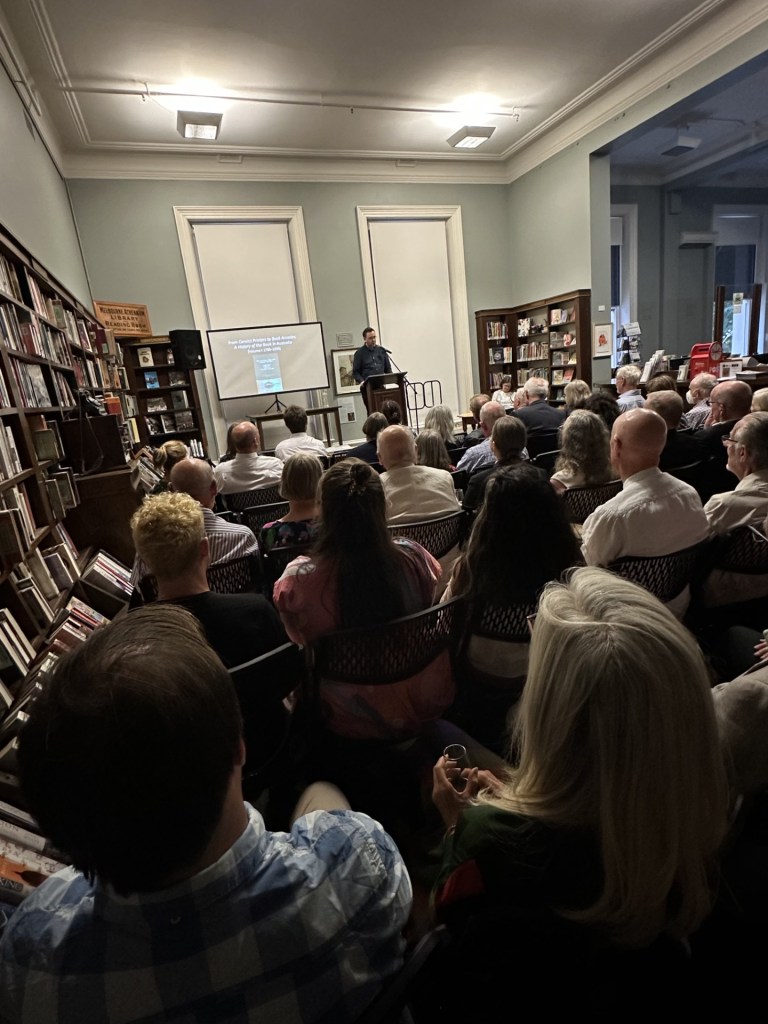
Stuart Kells’s speech at the launch of From Convict Printers to Book Arcades: The History of the Book in Australia Volume 1.
Acknowledgement of country.
Distinguished guests and representatives of Melbourne’s book community.
It’s great to be back at the Athenaeum Library.
Thanks for the opportunity to launch this important book – the definitive publication of the Ancora Press.
Over a span of many years, my friend Professor Wallace Kirsop has nurtured both the book and the press.
The story of this book – described by Wal in the preface, and soon to be the subject of a write-up in Australian Book Review – was unusually drawn out and tortuous.
The story reflects the difficulties of publishing today, but also the commitment of the authors, editors and publishers who brought the book into being.
In its finished form, it shows many traces of the journey.
It has been conceived and designed deliberately as a companion to two other volumes: A History of the Book in Australia 1891-1945, edited by Martyn Lyons and another friend, John Arnold; [and] Paper Empires: A History of the Book in Australia 1946-2005, edited by Robyn Sheahan-Bright and Craig Munro, famously one of the early editors of Peter Carey.
Like many people, I have used those books as essential resources.
They were invaluably helpful for my histories of MUP and Penguin Books; and the new volume will be important for several books that I have underway.
The scope of the new volume complements the other two, this one covering the years 1788 to 1890.
The format is similar even to the point of having the same image on the spine, and the same type of lamination on the dust jacket.
The scope of the present volume is analogous to the earlier ones; it covers authors, printers, publishers, booksellers, librarians, lending libraries, circulating libraries and much more besides.
Some of the publishers and booksellers were nefarious characters, as has always been the case, and they add drama to the story, as do notorious authors such as Fergus Hume, whose world-famous book, The Mystery of a Hansom Cab – the inspiration for Arthur Conan Doyle’s A Study in Scarlet – was published when Melbourne was one of the wealthiest and most exciting cities on the planet.
The present volume is part of an international enterprise; with linkages to analogous works in France, Canada and the British Isles.
The finished product is nothing less than spectacular – an indispensable contribution to Australian publishing, Australian print studies and Australian bibliophilia.
The first essay, by the late Penny van Toorn, is one of the most important Australian essays ever written about books – or indeed about any subject.
It changes how we think about the book in pre-colonial Australia; and it changes how we think about the book in general, including as something that is less reliable and less authoritative than oral stories grounded in country.
Van Toorn acknowledged that there was already a vibrant story culture in Australia – and in an important sense a book culture – prior to colonization.
This is one reason why I have urged the leaders of the State Library of New South Wales to stop referring to that library as the oldest in Australia.
Indigenous Australians are present in this new volume all the way through, not as a fleeting or polite or hollow acknowledgment but as drivers and pivotal contributors to the story of the book in Australia. The book goes a long way towards genuinely filling gaps in that story.
I was also delighted to read Wal’s statement that, compared to the English, Australians share equal ownership and have an equal stake in Shakespeare.
I would go further and say that, not only do we have an equal stake, but from this distance we can better see his work, and the scale of his achievement in the context of early modern writing and print production.
There are many other things, too, that we can see better and do better from Melbourne and Australia.
This book acknowledges many world firsts and world-class landmarks – such as our state and national libraries, Cole’s famous book arcade, Ferguson’s bibliography of Australia – and our world-class network of book-lovers.
Melbourne is a very bookish place, and Melbourne’s book community is full of hyper-competent and ultra-generous people. Barry Jones is one example; Wallace and Joan Kirsop are two others.
In my work on libraries, Barry, Wal and Joan provided invaluable editorial advice. When I toured major libraries around the world, Wal provided generous introductions to the rare book librarians at the Houghton of Harvard; the Bodleian at Oxford; and other unmissable institutions.
Wal’s generosity has taken other forms as well, including his publication of my Jean Whyte lecture as an Ancora publication; his invitation to join SLUORC, the State Library of Victoria’s library user’s committee; and his acknowledgment in this book of my and Chares Stitz’s work in publishing the five-volume Australian Book Collectors series.
The work of Wal and his fellow editors and contributors is a celebration of the physicality of books, and the richness of the story of books and print culture in Australia.
The work is another reminder, too, that libraries are and should always be primarily about books.
It is easy and seductive to be drawn down the path of multimedia and social services; of art spaces and digital hubs; or of Twilight and Harry Potter nights.
These are all fine as adjuncts and addenda; but the core of a library must always be books.
In many ways we are at a paradoxical moment in history; one paradox is that libraries are under threat, just when an interest in the physicality of books is at a high point.
With From Convict Printers to Book Arcades, published handsomely in non-digital form and full of first-class bibliographical scholarship, the editors and contributors remind us of what is lost when books are filed in the category of obsolete media.
It is therefore with gratitude and wary optimism that I now declare this book launched.
Thank you.
 Library Planet